Showing posts with label foraging. Show all posts

Thursday, November 4, 2010

Death by Matsutake


I went matsutake (Tricholoma magnivelare) hunting this morning at 6:30 AM. I had to be back in Seattle before 12-noon, and I am happy to say I had a successful hunt and made it back in time, too.

The drive to Lake Kachess, about an hour East via I-90, was beautiful at that hour. It was dark when I started. The moon was a tiny sliver, low in the sky and I drove into the sunrise. Here is Lake Kachess with rising morning fog:
I found so many matsutake! The name is Japanese for Pine Mushroom because they grow in association with Pines and have a spicy pine/radish/cinnamon odor and taste. They are very distinct, I don't think you can confuse it with any other mushroom if you combine the distinct odor with a few characteristics such as:
manly white mushroom with brown fibrils on cap, a squat appearance, thick cottony veil:
that is often fully intact:
tapered/rooting stem with brown scales:

Matsutake often completely develop under "duff," leaf and needle litter on the forest floor. You see puffed up, bulging areas of dirt and if you excavate further, you find this:
a nearly missed matsutake.
Here is an older fruit body. The cap has alredy turned upward and the gills have turned pink with age:
The odor/taste is strange. I actually like it, but I'm the type that sniffs every mushroom I see (I'm trying to learn all the mushroom odors - there are thousands). It was really satisfying to collect matsutake and get a "stamp of correct i.d."

I found my first matsutake last year (here's the post) and ate it sliced thin in a broth soup. It was pretty good. This year, I found about 15 large matsutake. I gave 4 away so I still had way too many to eat. I decide to try every interesting sounding recipe I found so I could get them all out of my system and not have to worry about mushroom hunting or mushroom taste testing any more this year (the collecting season is over anyway).
Here are my ingredients (I'm really proud of myself for chopping everything before I stared cooking, for the first time in my life):
Here is what I made:
clockwise from top: Matsutake broth, grilled matsutake, Matsutake rice (gohan), and Matsutake sukiyaki (stir-fry noodle soup).
The best one was the sukiyaki, then the rice, then the broth soup. The grilled matsutake were not so good. I think it would have been better on a real BBQ grill, not our panini grill :)
Now, we are sick of matsutake (Death by Matsutake, as Adam said) and our freezer is full of matsutake leftovers. It's funny to think this is one of the most expensive mushrooms. It can be $100 / pound in Japan - though around $15-$25 / pound in U.S. As a reference, one average matsutake is 4-5 ounces. So, 4 mushrooms make one pound.
Here is the log bridge leading to the secret matsutake hunting grounds!

Here are the recipes I consulted:

Wednesday, November 3, 2010

Lobster mushrooms


Lobster mushrooms are actually two kinds of fungi: a white mushroom, usually Russula brevipes, parasitized by the bright orange fungus, Hypomyces lactifluorum.
Hypomyces turn purple with a chemical indicator (see below).

Hypomyces lactifluorum will make a good dye, which is why I care about these funky, contorted, parasitized, stinky, mushrooms.
Some people care about lobster mushrooms as edibles. I've actually never eaten one though I plan to some day.
I care about them for dye...and I must care a lot because I have gone through the most disgusting tasks to get them into the dye pot. Unfortunately, it's mostly my fault.
To illustrate:
I got 2 boxes of past-their-prime lobsters from a mushrooming friend.

They sat outside rotting and collecting flies for 4 days until I had time to cut off the red/orange Hypomyces. This (handling rotting, slippery, raw-meat-like mushrooms pieces) in and of itself was disgusting, but it continues...

Then I boiled them (mistakenly) in our house on our stove. They put off the most horrible chemical rotting smell I have ever experienced. I also dried some of the less rotten parts for winter dyeing.

I put the whole dye pot outside to cool while I aired out the house...for 7 days.
Using a cloth bag (after work, in the dark, wearing a headlamp), I strained the chunks from the liquid and had to throw the straining bag away and wash my hair in the shower (my hair had absorbed the horrible smell).
3 weeks later (last night) I attempted to use the dye. Over the 3 weeks, I had time to plan how to use the dye. Not what to use it on - that's easy - but how to actually get through the dyeing process. I still needed to heat the dyebath and let the wool soak in the warm dye.
My idea: use our car camping propane stove at the nearby neighborhood park, hahahaha!
Ideally, wearing a hazmat suit.

Results:
Though Adam and I had a nice night at the park
on the slack line
while the dye pot simmered,
I must say I am bummed to not have gotten the dark purple colors I was hoping for. Many people mention getting cinnamon pink colors, which it probably a fitting description for what I have.
I dipped half of the skein in iron mordant (blue while wet, orange when dry) and the other half was alum mordant.

Saturday, October 9, 2010

Tumwater Campground mushrooms

Laccaria amethysteo-occidentalis (not the best picture, look them up online....)

Another mushroom collecting trip to Tumwater Campground near Leavenworth, WA. It's an unsuspecting place - a dry, campground area near a cottonwood lined river - but the weather conditions this year made this campground bursting with millions of mushrooms non stop for a month. Incredible!
Leucopaxillus giganteus (There were hundreds of these gigantic mushrooms. Look at the white spores pouring from their gills and covering the ground!)
Lycoperdon perlatum (the first mushroom I ever learned. I found one in Iceland and thought it was amazing)
Helvella lacunosa (above)
Fairy Ring Marasmius oreades (above).
Suillus tomentosus (cap, pores, stipe all yellow, no veil, base white and pink)
Suillus lakeii (above)
Boletus chrysenteron (dry, velvety grey-brown cap.Gills/flesh bruise blue)
S. lakeii, B. chrysenteron, and B. zelleri for comparison.
Amanita _ check out this volva/ universal veil!!!!!

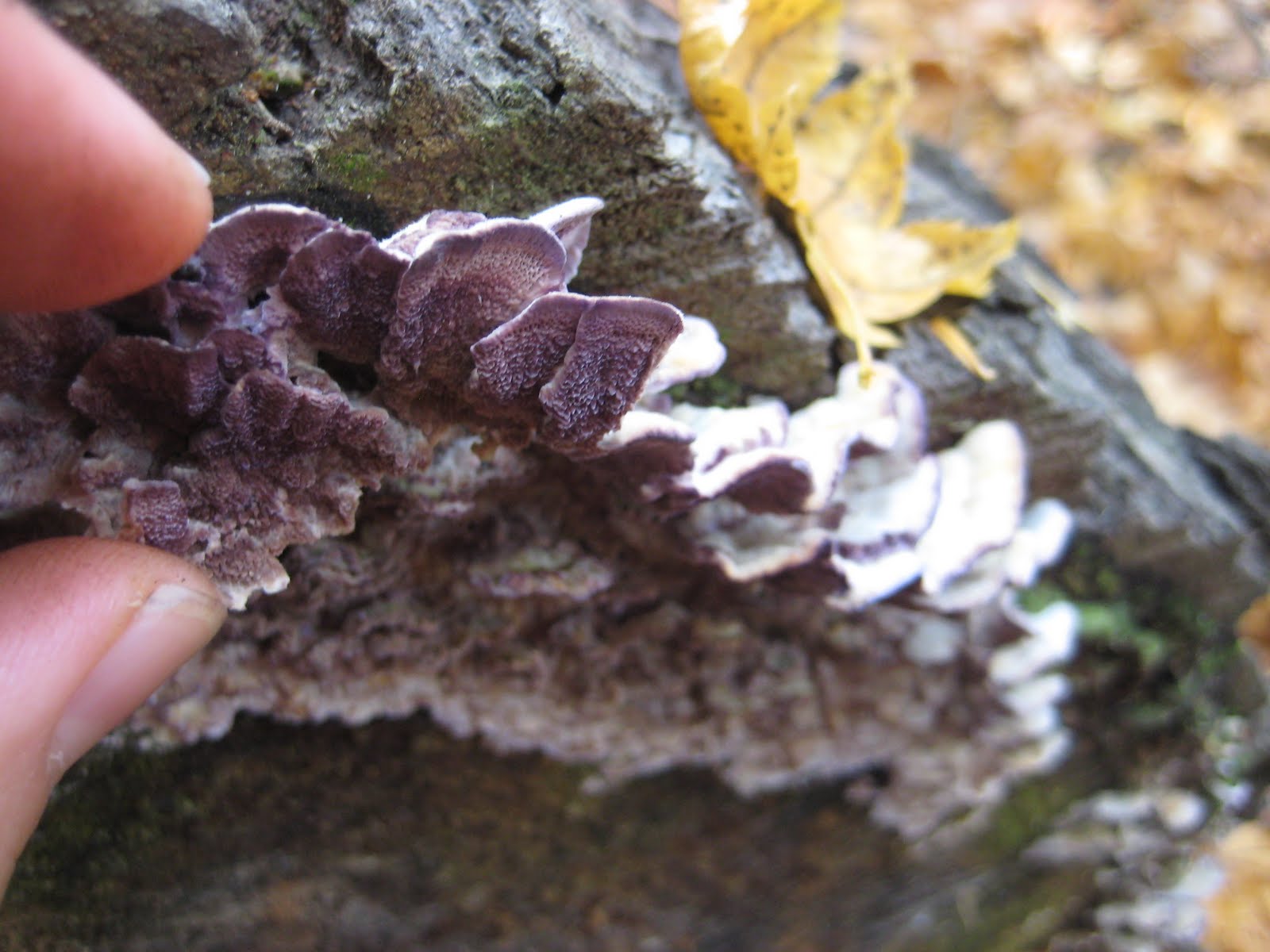
Trichaptum abietinum (purple tinged, on conifer logs)
Chroogomphus pseudovinicolor, a possible dye species, we shall see...
And finally:
Clitocybe odora (grey-green-blue gills, strong anise smell)

I also saw Lactarius deliciousus, Lactarius rubrolactius, Boletus edulis, and Hericium abietes.

Thursday, September 23, 2010

Barlow Pass mushrooms

Ah, mushroom season is upon us at last!!!!!
Here are some recent finds from Barlow Pass, Washington (On Mountain Loop Hwy, ~2 hours north of Seattle).
Starting with the cutest: Pseudohydum gelatinosum, a clear, jiggly little fungus with spines instead of gills.

Hygrophoropsis olida, a small, pink, funnel shaped fungus that smells incredibly sweet like SweetTarts or grape soda!


Hygrophoropsis ferruginea (below left) and Hygrophoropsis aurantiaca (below right)

Mycena aurantiodisca, center of cap is almost red-orange fading to orange, yellow, and white. Gills are white.

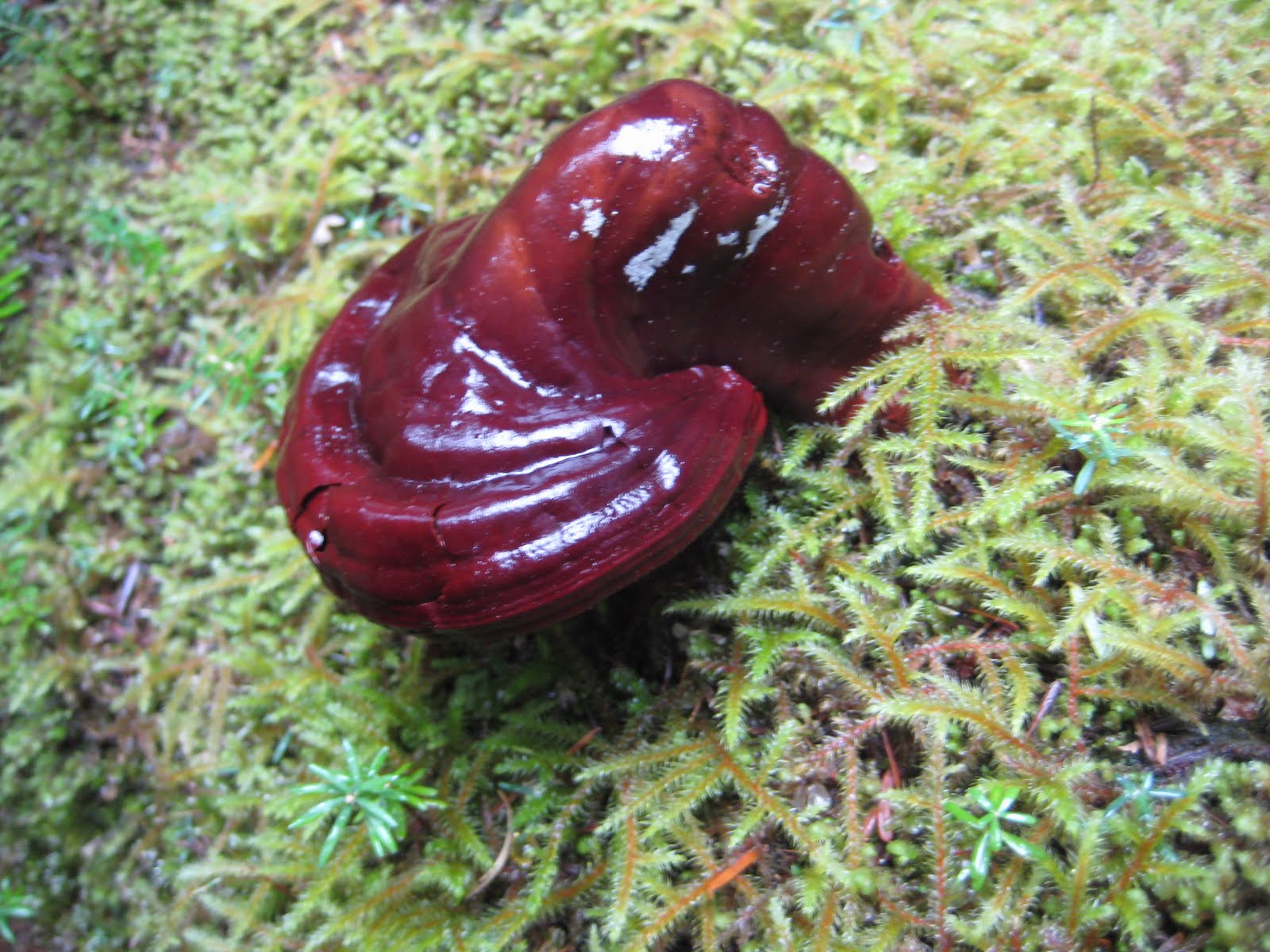
Ganoderma oregonensis, a polypore with a distinct red lacquer/varnish appearance.


Lactarius olympianus, like Lactarius deliciousus group, but with white latex instead of orange lates (see photo)

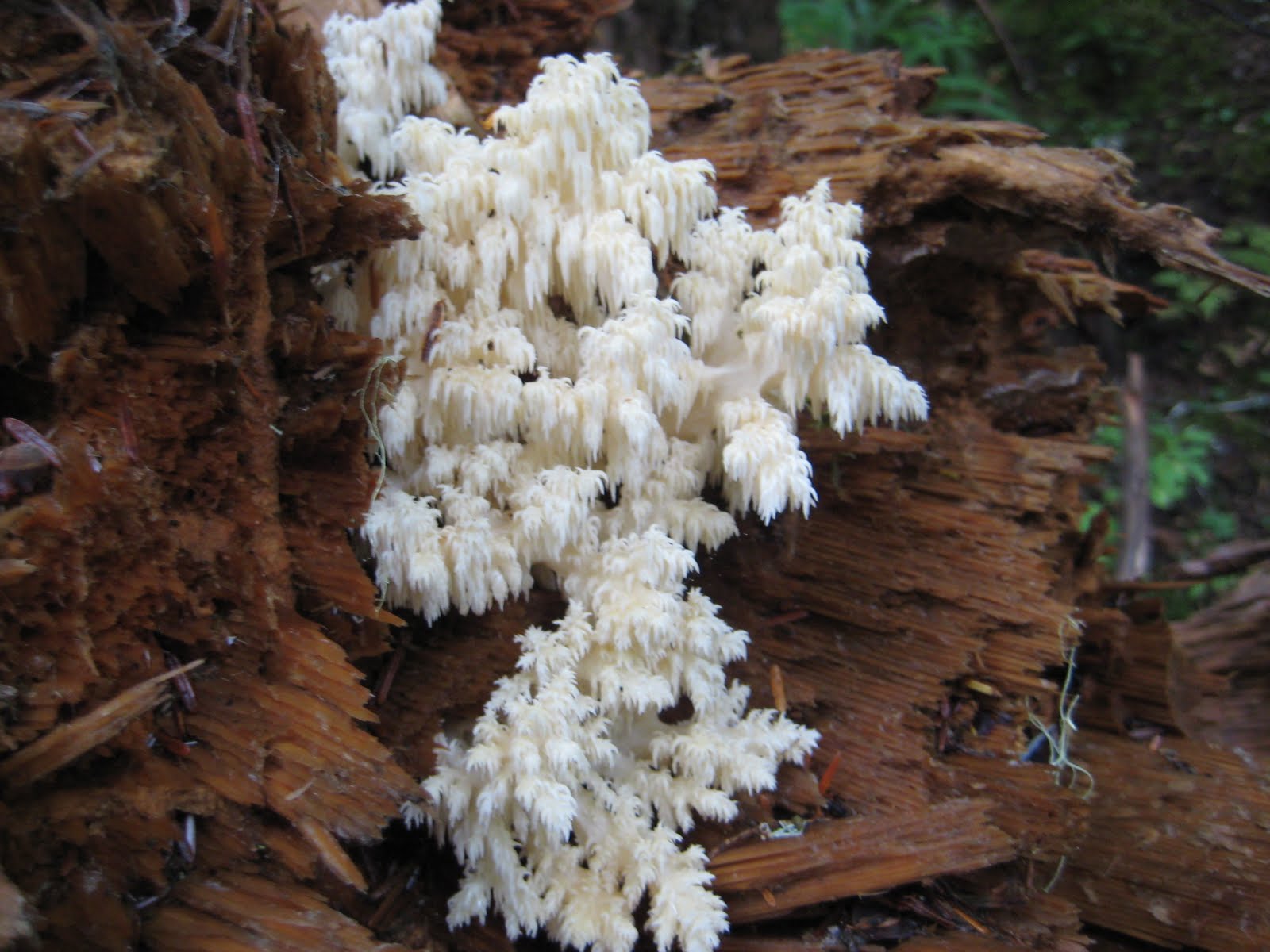
Hericium abieties, a (delicious) tooth fungus that looks like icicles. It grows from fallen and cut logs. Last year we had a feast of these!

Gomphus floccosus, (below) not as scaly as it can be:

Gomphus kauffmanii, (below) light colored - not orange. Very scaly; long curving scales forming a rosette in the cap depression.

Chalciporus piperatus, will dye orange :)

Nidula candida, bird nest fungi! I never get tired of these!


Pleurocybella porrigens, Angel Wings:

Clitocybe connata, likes disturbed sites like roads, trails, ski slopes:

Pholiota flammans, will give a yellow dye!


Boletus zelleri, will give a yellow dye, I tried it last year.

???

Rozites, or Cortinarius caperatus, an edible Cortinarius:

Stropharia hornemannii:

Craterellus tubaeformis, and edible chanterelle-like mushrooms with wrinkles instead of gills.

Whew, that's all of them.
I like to keep species lists from collecting trips. It helps me memorize the fungi and remember what I can expect to find at a certain location and time of year.